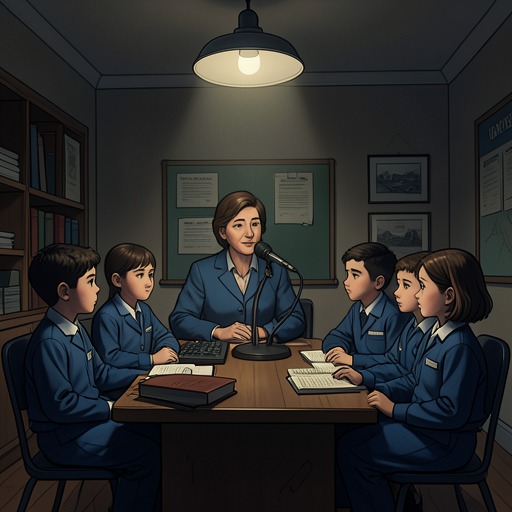
Miss Lucy retracts her reassurance to Tommy
Never Let Me GoMiss Lucy retracts her reassurance to Tommy in a conversation that turns a private act of comfort into an admission of harm. She had once told him not to worry about his creativity; now she says that advice was a mistake, and that his art matters not only as evidence but for what it can mean to him. The encounter revisits an earlier moment between them while exposing a tension between the institutional value assigned to students’ art and its personal value to the person who makes it.
Account and Retrospective Frame
Kathy H. learns about the encounter from Tommy, who says that he has been thinking about Miss Lucy constantly. The scene therefore reaches the reader as an episode Tommy relates to Kathy, then as a memory Kathy arranges in retrospect. She places it near the beginning of that summer, a few days after she had seen Miss Lucy in Room 22 writing over her paperwork. Kathy later regrets not having learned what happened from Tommy sooner; her reconstruction links two separate glimpses of Miss Lucy’s unease without suggesting that she understood its cause at the time.
Tommy’s opening explanation also gives the story a small but consequential turn. He has been discussing something with Kathy, but says that his real concern is something else altogether: Miss Lucy. The memory that follows shifts the focus from whatever had prompted their conversation to the unresolved effect of an earlier reassurance. What Tommy carries forward is not simply a judgment about his drawings, but a conversation whose meaning has changed since he first heard it.
The Encounter in the Orangery
The meeting takes place in the afternoon during the dead hour, after lessons and before supper. Tommy sees Miss Lucy leaving the main house with her arms full of flipcharts and box files. Thinking that she might drop them, he offers to help. She gives him some of the load, but even carrying it together they drop a couple of things on the way. Near the Orangery, she stops and looks directly at him, seriously, then says that they need to talk. They carry the things into her study and put them down.
Miss Lucy tells Tommy to sit. He finds himself in the same place as during their previous conversation years earlier, and he senses that she remembers it too. The physical return to that spot makes her correction feel belated: she is not offering new advice in an unrelated setting, but reopening a promise of reassurance she now believes she should never have made. In Tommy’s account, she begins without explanation, telling him she made a mistake and should have put him right long before.
What Miss Lucy Retracts
Miss Lucy tells him to forget what she had said before: that he did not need to worry about being creative. She now says the other guardians had been right and that there had been no excuse for his art being so poor. Tommy recalls her description uncertainly. When Kathy asks whether Miss Lucy actually called the art rubbish, he says that she may instead have used words such as negligible or incompetent, but that the implication was much the same. His hesitation preserves an important distinction: the exact insult is unclear, while the severity of the judgment is not.
Tommy says that he did not know what to answer. Miss Lucy asks what he is thinking, and he tells her he is unsure but that she need not worry because he is all right now. He explains that people no longer laugh at him about his art. That response measures his present relief against the long period in which his drawings had made him a target: he is not asking her to restore his confidence, and he does not consider the old injury an immediate problem.
Miss Lucy refuses his attempt to settle the matter. She keeps shaking her head and insists that he is not all right, that his art is poor, and that her earlier reassurance was partly to blame. Tommy understands that she is speaking about what lies ahead after they leave Hailsham. He answers in terms of physical fitness and the coming donations, saying he will be able to manage them well and look after himself. Her vigorous shaking of her head makes plain that his answer has missed the point she is trying to make.
Art, Evidence, and Personal Value
Miss Lucy finally tells Tommy that his art is important, not only because it is evidence, but for his own sake: he will get something from it personally. Her correction does not simply replace praise with condemnation. It separates the value of creating from the question of whether his work meets the guardians’ standard, and from the art’s role as evidence. Tommy has treated future survival and physical readiness as the relevant measures of being all right; Miss Lucy insists on a value that those measures cannot encompass.
The scene remains unresolved in the evidence given here: it records Miss Lucy’s confession, Tommy’s response, and the principle she tries to leave with him, rather than a later decision by Tommy to draw differently. Its force lies in the reversal between the two conversations. A reassurance meant to relieve him has become, in Miss Lucy’s judgment, a disservice; correcting it means telling Tommy something painful, but also insisting that his art belongs to his life, not merely to an external test. Because Kathy receives this account later, the exchange also shows how an old conversation can continue to trouble Tommy after the immediate embarrassment around his drawings has eased.